 Preferium
GoogleAI Search
Google swapped the model behind AI Mode and the source links stopped appearing
Gemini 3.8 Flash landed in AI Mode on 2 September. Within a day, SEOs were posting screenshots of answers with no citations at all. Google calls it a bug — but the exposed dependency is real.
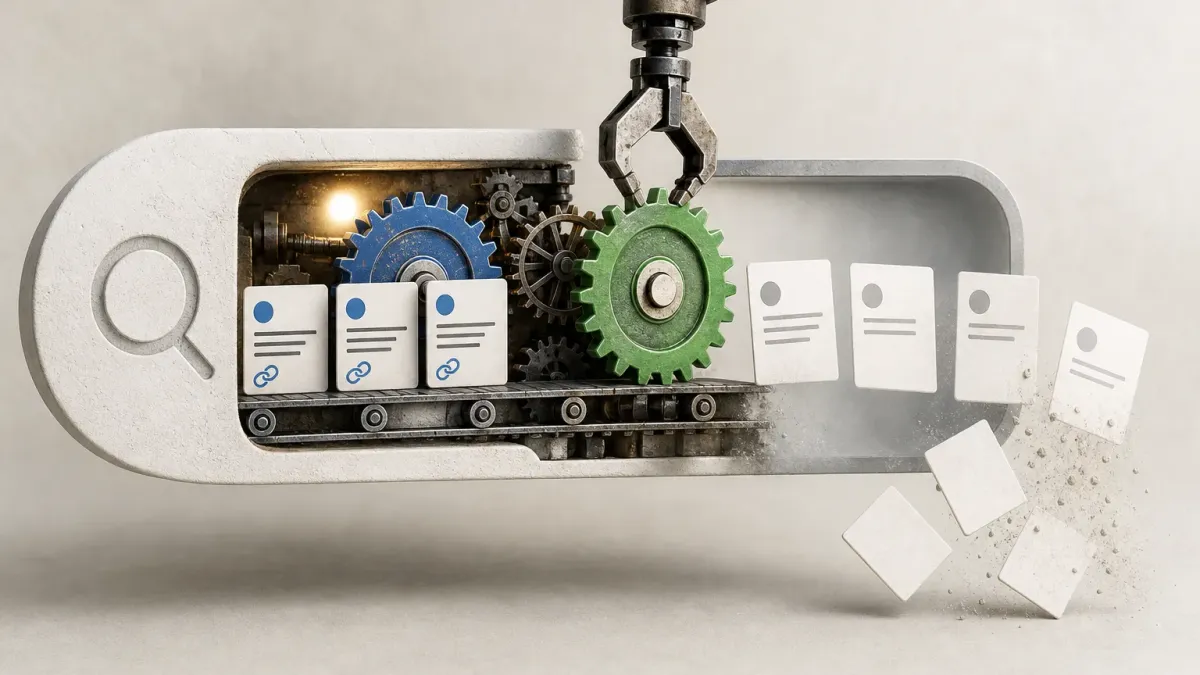
TL;DR: When Google answers a question with AI-written text instead of a list of links, it usually puts a few small source links next to the answer. Those links are how a website still gets visitors out of an AI answer. On 2 September Google put a new AI model, called Gemini 3.8 Flash, inside AI Mode. Within a day, people were posting screenshots of answers with no source links on them at all. Google’s VP of Product for Search replied publicly that this is not intended and a fix is coming. Only paying subscribers who had actively picked that model were affected. The bug will be gone in days. What it showed will not be: whether your site gets credited inside an AI answer now depends on which model happened to write it, and Google is shipping new models faster than most agencies re-run their reports.
First, what a “model picker” is doing inside a search engine
Two terms, both plainly:
A large language model is the piece of software that actually writes the answer text. Not the index of web pages, not the ranking system — just the writer. Google has several, and they get replaced often.
A citation here means the small link Google shows next to an AI answer saying where a claim came from. If you run a website, that link is the whole point. It is the only route from an AI answer back to your pages.
AI Mode is Google’s conversational tab, where you go back and forth with Google rather than scanning ten blue links. Since July, it has had a model picker: a “+” icon in the search bar that lets subscribers choose which model writes their answers. Free users get whatever Google has set as the default.
So Google Search now has a swappable writer in it. That is the setup for what happened on 2 September 2026.
What people actually saw
Google announced Gemini 3.8 Flash on 2 September, calling it “our third Flash release in only six weeks”. Robby Stein, Google’s VP of Product for Search, said the same day it was live in AI Mode for Google AI Pro and Ultra subscribers worldwide.
The next day the screenshots started. Gagan Ghotra and Glenn Gabe both posted side-by-side comparisons on X: the same query, run through 3.8 Flash and through the default model. The default answer carried its usual set of source links. The 3.8 Flash answer carried none. Broad, early-stage questions — the “what is X”, “best way to do Y” kind, the queries where a publisher has the most to gain — were hit hardest.
Stein replied on X, quoted by Search Engine Land: “This isn’t working as intended, and we’ll roll out a fix soon.”
Take that at face value. Google has spent a year telling publishers that AI answers will keep sending traffic to the web, and an answer with zero attribution contradicts that badly enough that nobody would ship it deliberately. The blast radius was also small: you had to be a paying subscriber and you had to have gone into the picker and chosen 3.8 Flash yourself.
The part that outlives the bug
Here is what the incident demonstrates, independent of whether Google fixes it by Friday.
Citation behaviour is a property of the model, not of your page. Same index, same ranking, same content, same query — different writer, and your link is gone. Nothing about your site changed.
Google is now replacing that writer every two to three weeks. Three Flash releases in six weeks, by Google’s own count. AI Mode’s picker gained 3.7 Flash in mid-August and 3.8 Flash two weeks later.
That combination breaks a lot of casual measurement. If your monthly AI-visibility report says citations dropped 30%, you cannot tell from the number alone whether you lost ground, whether the query mix moved, or whether a different model wrote the answers that month. Anyone spot-checking AI Mode by hand needs to log which model was selected, or the check means nothing. And a monthly cadence is simply too slow for a surface that changes on a fortnightly one — you’d be reading a distribution that no longer exists.
Worth saying clearly: today’s bug never touched the free default model, so the vast majority of AI Mode traffic was unaffected. The exposure is structural, not a current emergency.
What to do about it
Three things, none of them exotic.
Log the model with every AI Mode observation. If you are checking AI Mode manually, screenshot the picker state too. An observation without the model attached is not comparable to next month’s.
Measure often enough to see a step change. A citation count that moves the week Google ships a model is a model effect. The same count seen once a month is noise you cannot decompose. Frequency is what makes the difference readable.
Do not restructure content around a two-day bug. Nothing in the reporting suggests 3.8 Flash cited a different sort of source — it cited nothing. There is no lesson here about schema or headings or entity coverage. Sit still.
The genuinely tedious part is the frequency. Checking six answer surfaces often enough to catch a model swap, across a portfolio of clients, is not something a person does by hand every fortnight. Tracked apart from the assistants, AI Mode gets its own line, so a citation drop that begins on the day Google changes models shows up as a dated movement on that line rather than a hunch in someone’s inbox. That is the same distinction Google’s own new Search Console AI report draws between AI Overviews and AI Mode.
Key takeaways
- Gemini 3.8 Flash arrived in AI Mode on 2 September and, for some queries, returned answers with no source links at all.
- Google’s VP of Product for Search confirmed it is unintended and a fix is coming; only Pro and Ultra subscribers who manually selected the model were affected.
- The default model that free users get was never involved, so this was not a traffic event for most sites.
- The durable finding: whether you get cited depends on which model writes the answer, and Google shipped three Flash models in six weeks.
- Log the model version with every AI Mode check, and measure often enough that a model swap shows up as a step change rather than a mystery in a monthly report.
- Do not rewrite content in response to this. The model cited nothing, not something different.