 Preferium
AI VisibilityAI Search
A Bali study found most venues absent from AI recommendations
An audit of 4,776 Bali venues found 85.6% absent from its AI recommendations. Websites and listed prices were associated with inclusion; the study does not establish cause.
Jump to a section
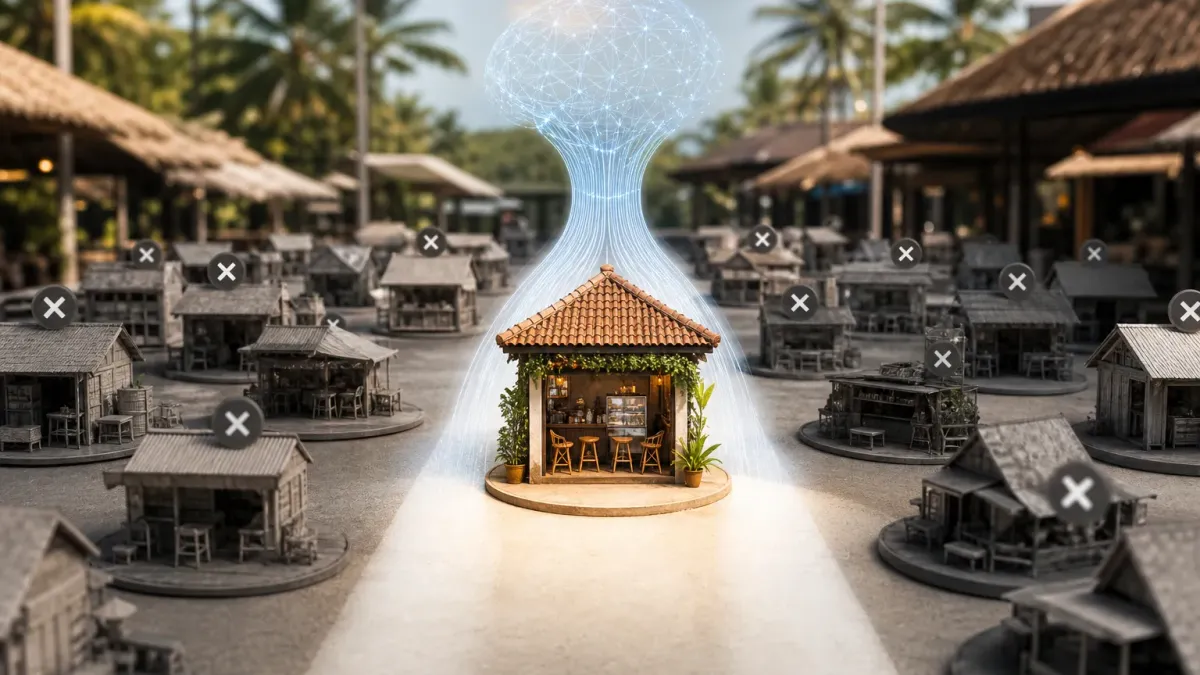
Most venues in a study of 4,776 Bali restaurants, cafes and bars never appeared in the sampled AI recommendations. The useful detail is what was associated with inclusion: a website, listed prices and third-party mentions. These are observed relationships, not a recipe proven to cause recommendations.
Why a “census” makes this study different
Most research into what AI assistants recommend starts with a list of well-known brands and checks how often each one shows up. That tells you who wins. It cannot tell you how many businesses lose, because the losers were never on the list.
This one worked the other way around. Vladimir Pitenin of Norly Research pulled every food-and-drink venue listed on Google Places in greater Canggu and greater Ubud — a complete count of the market, 4,776 venues — and used that as the denominator.
Then he ran 96 queries written in the voice of different kinds of traveller (“a quiet place to work”, “somewhere for a birthday dinner”), 2,208 responses in total, over seven days, against four assistants with live web search switched on: ChatGPT, Claude, Gemini and Perplexity.
The protocol was registered before collection. The paper, Invisible to the Machine, went up on arXiv on 7 August; PPC Land wrote it up on 23 August.
Because he could see the whole market, he could count the silence. 85.6% of venues were never recommended by any system in any run. Among venues with fifty or more Google ratings — real, established businesses with a track record — 72.6% were still never named.
Inclusion and position showed different associations
The interesting result is that getting into an AI answer and ranking well inside one are governed by opposite signals. The paper calls this a two-margin structure.
Getting in tracked with documentation — how much written, machine-readable evidence about the venue exists on the open web. Having your own website was associated with roughly 1.9 times the odds of being recommended. Review volume, about 1.6 times. Having your prices listed somewhere, about 1.5 times. Being mentioned on third-party sites, about 1.4 times. Star rating did not have a statistically significant association with inclusion in this sample (odds ratio 0.89).
Ranking flipped it. Among the venues that did get recommended, the rating started to matter — higher-rated places were more likely to land in first position, at about 1.17 times per standard deviation.
This suggests that documentation and reputation can matter at different stages. It does not reveal the assistants’ internal decision rules or show that an individual venue without a website cannot be recommended.
The study also tested another proposed factor. Being listed in Foursquare’s open point-of-interest dataset — widely assumed to feed AI systems — showed no positive effect at either margin.
Outdated information in the answers
Invented venues were vanishingly rare: 0.08% of mentions. But the systems recommended permanently closed businesses 93 times, across 14 establishments. Those examples make outdated opening status a practical concern. They do not establish where each system obtained the stale information.
Check your own location pages and the listings you control. Correct old addresses and clearly mark closed branches; do not assume that updating one profile updates every source an assistant might use.
Caveats worth stating
This is one industry in two neighbourhoods. Restaurants are not law firms and Bali is not Manchester. The numbers are associations from observed data, not proof that adding a price list causes recommendations — venues that publish prices differ from venues that don’t in other ways too. And Norly Research sells review-management and AI-visibility tools, which it discloses; the protocol and derived data are published, which is more than most vendor research offers.
Useful checks for local sites
For local client sites, use the findings to prioritize a few concrete checks:
- Get every client a real website, and make it readable without JavaScript. This is the largest single association in the study, and it is the one thing entirely within your control.
- Write the boring facts down as text on the page. Prices, hours, service area, what you actually do, whether you’re still open. Not in an image, not behind a booking widget.
- Correct outdated business information. Old addresses, closed locations, dead landing pages, outdated directory entries. Those are what gets recycled into answers.
- Chase mentions, not just links. Third-party write-ups mattered at the entry margin. A local blog naming you counts even without a follow link.
- Measure recommendations directly. A high star rating alone does not tell you whether an assistant names the business.